Friday, 30 September 2011

Homework for Monday, October 3rd, 2011:

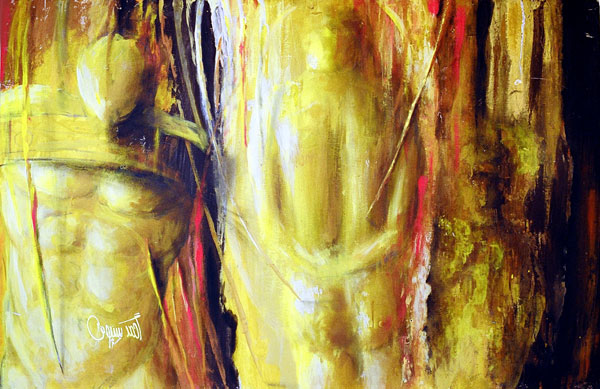
I chose the piece The Body & The Soul by Ahmed Basiony (seen below):


2. a) The reason I have picked this piece is because it is a painting, but to me looks nothing like one. There is a series of these "Body & The Soul" paintings but this one stuck out to me the most due to it's ability to actually pop-out at the viewer; it's quite sculptural. The use of the paint makes it look like these abstracted bodies are being constricted by various layers, quite forceful looking strokes as if painted with a pallet knife, it's full of texture and movement. While viewing the piece, the eye slowly picks up on details that aren't noticeable at first, such as the face and body in the lower right corner, while the contrast of light and dark makes quite the  appealing composition. 

b) Do you think artists should or should or should not be political, in their life? in their art? both? neither? why?

I think it is really all up to the artist. Their beliefs, values, and opinions - they should stay true to them all. To do what the public wants, or finds socially acceptable, or what will make the artist more money, is all in my definition of what "selling out" is. If being political in your life, or your art gets an artist some negative publicity, so be it. If you live your life, or create your art according to someone else's standards, there's no fun in it at all - and from what I've seen from my own art; if I don't enjoy making it, it's not usually good art.

Sunday, 25 September 2011

Response to High Art vs Low Art:

Trying to find a definition of what is "high art" or what is "low art" has turned out to be quite the task. If I had to take a wild guess of what high art/low art is, I'd say high art is refers to what is "in", what is tasteful or what is shocking; and low art is something that is tasteless, "out" or been done/seen before. That's what I can just imagine what the possible definition would be, but I guess it could be different for everyone, depending on that person's personal taste.

I think that this can definitely be applied to Culture, not that anybody wants it to, or decides which is "high" or "low" themselves, society always puts us into these groups; depending on your social status, how much material value you have, etc. These things can even be applied in smaller areas like friend groups - considering how certain people won't talk to you/befriend you based on what you're wearing or if you don't know the same people, and so on and so forth.

To lump things into two categories of "high/low" seems a bit ridiculous or extraneous, there are certain values that will always determine our positions whether we like it or not, or what anyone says.

Friday, 16 September 2011

First Response to Pages 19-37

First question: What is your opinion of the art of Andreas Gursky? Why?


At first I wasn't too keen on it, but on further exploration I have decided I like it. It seems to have a visual pull towards it.

Take this picture for an example. It actually feels like the left and right sides are pulling you into the picture. The bright colours are also captivating, but the use of repetition is almost calming, numbs the mind, makes my eyes relax and want to continue staring at this piece.

I know not all of his works look quite like this one, yet all of them in their own way have this trance-like effect, the one below keeps my attention because it almost looks like an optical illusion.


Although as fond as I am of all the works I've seen of his so far, I don't' really know if I'd ever want to purchase a piece and hang it up in my house; I go for things that are less abstract and more aesthetically pleasing, but I certainly would like to go see an exhibition of his work.

Second question: What do YOU think the value of art should be based on? Do you agree or disagree with Graw’s viewpoint?

I honestly think that the value of art should be based on dedication, and how much of yourself you put into the work. Consideration, time, effort, and emotional value;  I’m not going to pay a lot of money for a single brush stroke on a canvas that has “so much meaning” and I’m not going to sell a piece of artwork I spent weeks on, for less than I think it’s worth.

As for Graw's viewpoint, it seems quite vague to me. She mentions a lot of things that do contribute to the value of artwork, or things to be considered; such as market value, material value, symbolic value, whether it's one-of-a-kind of not, but I feel as though she's always beating around the bush of a straight answer - so I can't really agree or disagree with her viewpoint. I mean there's certain things she says that I do agree about but as a whole I find it a tad confusing.